
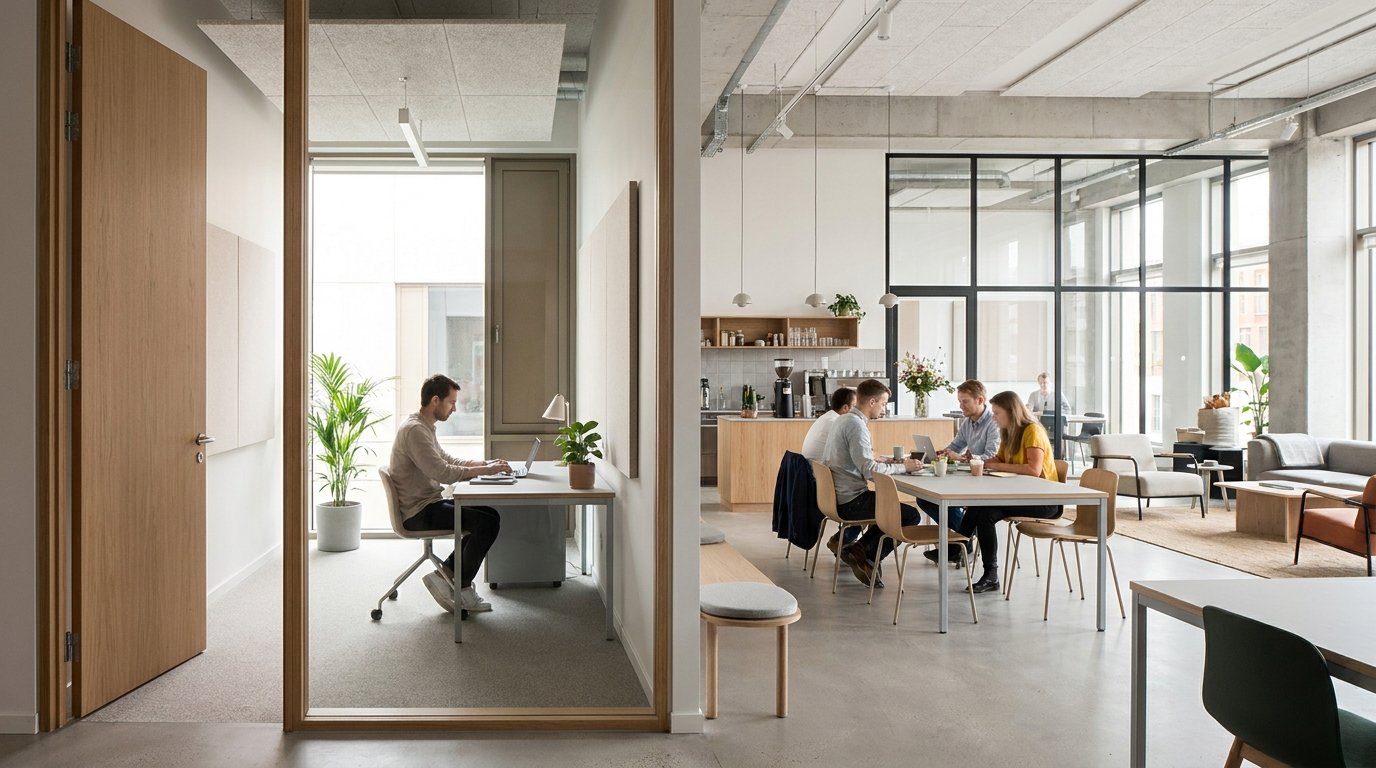
Choosing between a private office and coworking in Markham comes down to a simple trade-off: coworking is cheaper and more flexible, while a private office gives you privacy, quiet and a professional setting. If you work solo a few days a week, coworking usually wins. If you need daily focus, confidential space or a branded room, a private office earns its cost. Here is how to decide.
This is an honest private office vs coworking comparison — not a sales pitch for one over the other. Both are good options for different people, and the right answer depends entirely on how you actually work, how private your work needs to be, and how many people are on your team. We will walk through what each one is, the real pros and cons, what they cost, and where a dedicated desk or virtual office fits for people who do not need daily space.
What is coworking?
Coworking is a shared, open workspace. You sit among other members in a common area, usually wherever there is room, with internet, coffee, printing and shared amenities included in one membership. A hot desk is the most flexible version — you turn up, find a spot, and work.
Coworking is built around flexibility and low cost. It suits solo founders, freelancers, remote employees and anyone who wants to get out of the house a few days a week without committing to a fixed spot or a long lease. Across the market, coworking and hot desks are the cheapest way to get a professional place to work.
The trade-off is privacy and consistency. You cannot leave a monitor set up overnight, confidential calls mean booking a separate room, and the ambient noise of a shared space is not for everyone. Some people thrive on the energy; others find it hard to do deep work.
What is a private office?
A private office is a lockable room that is yours alone. You can leave your equipment set up, take confidential calls at your desk, brand the space, and close the door when you need to concentrate. In a serviced building, the room comes with internet, utilities, furniture, reception and meeting-room access bundled in, so you get privacy without running your own fit-out.
A private office is built around focus, privacy and a professional impression. It suits small teams, client-facing businesses, and anyone handling sensitive information — legal, financial, medical or otherwise. The trade-off is cost: you pay more than coworking because you are not sharing the room.
Private office vs coworking: the honest comparison
Here is a like-for-like view of the two options, with a dedicated desk added as the middle ground. Treat the market context as typical for 2026 and worth verifying for the exact space you want; the pricing shown reflects Markham Office's own all-inclusive rates where noted.
| Factor | Coworking / hot desk | Dedicated desk | Private office |
|---|---|---|---|
| Cost | Lowest — cheapest option in the market | $299 / month (our all-in rate) | From $1,000 / month (our all-in rate) |
| Privacy | Low — open, shared space | Medium — your own desk, shared room | High — lockable, private room |
| Best for | Solo, part-time, flexible days | One person in most days | Small teams, client or confidential work |
| Commitment | Most flexible, month to month | Flexible, month to month | Flexible terms, no multi-year lease needed |
The pattern is clear: as you move from coworking to a dedicated desk to a private office, cost and privacy both rise together. The skill is matching that spend to what your work actually requires.
Cost: what each one really costs
Coworking is the cheapest way to have a professional base — hot desks sit at the bottom of the market on price. If keeping monthly costs as low as possible is the priority and you can work in a shared setting, coworking is hard to beat.
A dedicated desk is the affordable middle ground. Our own dedicated desk is $299 per month, all-inclusive, which gives you a fixed spot in a shared room along with internet, a business address and monthly meeting-room credits.
A private office costs more because privacy costs more. Our private offices start from $1,000 per month for a room suited to a small team, and that price is all-inclusive — internet, utilities, furniture, reception, a business address and meeting-room credits are all part of it. When you compare, always compare totals rather than headline rents, because a bundled serviced price often beats a "cheaper" bare option once you add everything up.
Privacy and focus
This is where the two options diverge most. In coworking, privacy is something you book — you step into a meeting room for a confidential call and return to the open floor afterwards. That is fine if sensitive conversations are occasional. If they are constant, the friction adds up fast.
A private office makes privacy the default. Confidential calls, sensitive documents and focused deep work all happen behind a closed door. For anyone handling client, legal or financial information, that is not a luxury — it is a requirement. And if open-plan noise is quietly hurting your concentration, a private room can pay for itself in the quality and quantity of work you get done.
Team size
Team size is often the deciding factor. A solo worker or a two-person team that is together only occasionally can do well on coworking or dedicated desks. As soon as a team is in most days, sharing an open floor makes collaboration and confidentiality harder, and a private office starts to make more sense.
Once you grow past four people, several coworking memberships usually cost more, and scatter your team, compared with a single dedicated team suite that keeps everyone together in one branded space. Growing teams almost always land on private space in the end; the question is just when.
When each one wins
To make it concrete:
- Coworking wins when you work alone or part-time, want the lowest cost, value flexibility, and do not need daily privacy.
- A dedicated desk wins when you are one person in most days and want consistency without paying for a full private room.
- A private office wins when you need daily privacy, handle confidential work, take frequent calls, want to brand your space, or lead a small team that is together often.
There is no universally right answer — only the right answer for how you work today, with room to change as you grow.
Where a virtual office fits
Not everyone needs to sit somewhere every day. If you mostly work from home or on the road and simply need a credible Markham presence, a virtual office is the most economical choice of all. It gives you a real business address and mail handling without renting a desk, and you can add a day office at $75 per day or a meeting room at $25 per hour on the member rate ($35 for non-members) only when you actually need in-person space — far cheaper than paying monthly for space that sits empty. By comparison, market day offices such as Regus are priced at around $95 per day, so booking space only when you need it keeps costs low. Learn more on our virtual office page.
How to decide
Match the space to how you genuinely work, not to how big you hope to look. Ask three questions: How private does my work need to be? How many days a week am I actually in? And how big is my team, now and soon? Your answers point clearly to coworking, a dedicated desk, a private office, or a virtual office plus occasional bookings.
If you have decided that privacy, focus and a professional space are worth it, take a look at our dedicated office options in Markham — from a $299 dedicated desk to a private office from $1,000 per month, all-inclusive and quoted up front. And if you want to see the full picture on rates first, our guide to office space cost in Markham breaks every option down side by side. Whatever you choose, choose the space that fits the work — that is the decision that pays off.