
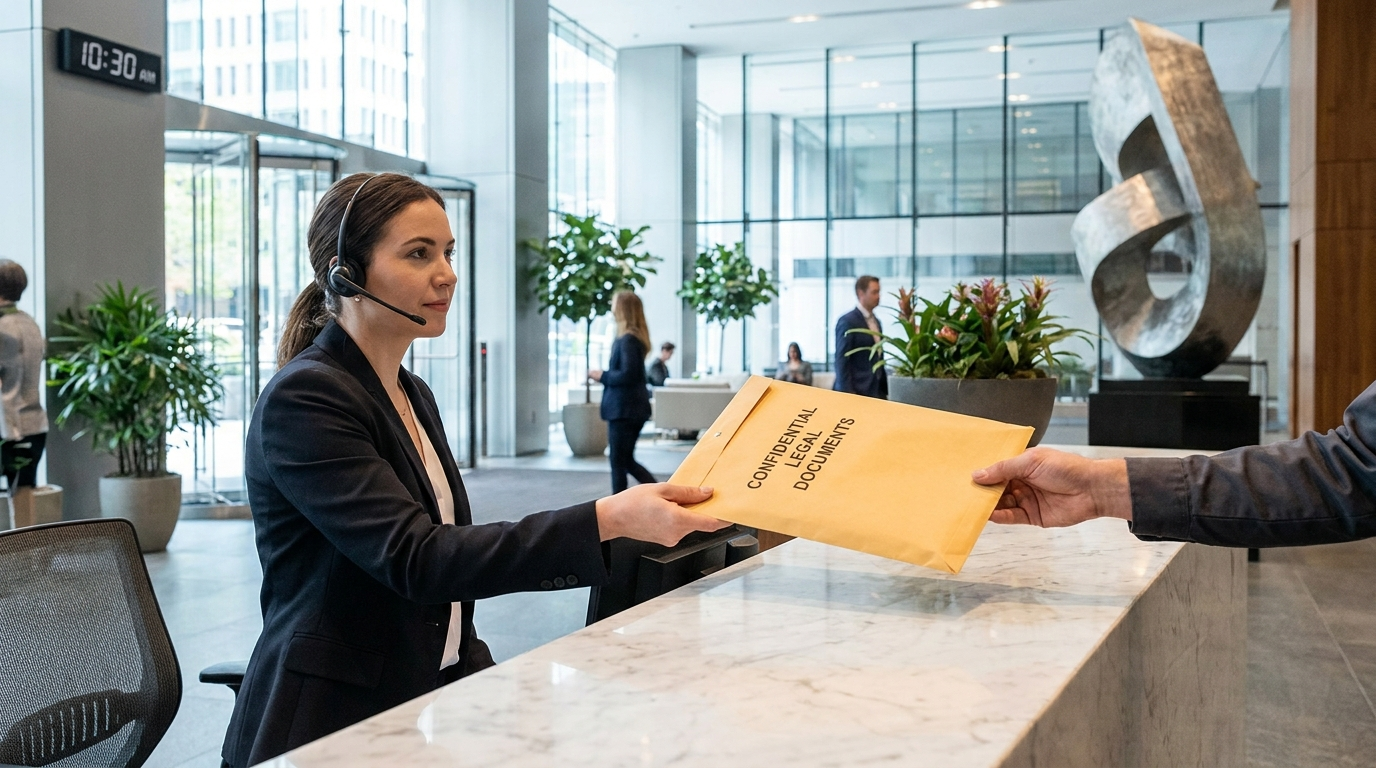
A registered office address in Ontario does not require a named employee sitting at the desk every minute, but it does require a real municipal street address — not a P.O. box — where your corporate records are kept and where documents and legal notices can be received during business hours. An ultra-cheap, address-only mailbox plan often falls short of these registered office requirements.
That gap matters, because the registered office is the one address the government, the courts and other parties rely on to reach your corporation officially. This guide explains what the Ontario Business Corporations Act (OBCA) expects, what the "present during business hours" idea really means, why a P.O. box does not qualify, and how a staffed virtual office fills the role properly.
What a registered office is under the OBCA
Every corporation incorporated under Ontario's Business Corporations Act must have a registered office in Ontario. It is not a service you buy for convenience; it is a legal fixture of the corporation that appears on the public corporate record. Two things sit at the heart of it.
First, the registered office is where your corporate records are kept — or at another place in Ontario that the directors formally designate. Under the OBCA, a corporation must maintain records such as its articles and by-laws, minutes and resolutions of shareholders, the register of directors, the securities register, and the more recently required registers (including the register of individuals with significant control). Certain shareholders, beneficial owners and creditors are entitled to examine parts of these records during the corporation's usual business hours.
Second, the registered office is the official address where documents can be served on the corporation. When a government body, a regulator or a party in a legal matter needs to formally deliver something to your company, the registered office is the address they use. That is precisely why the address has to be real and reachable.
Registered office requirements: does someone need to be present?
Here is where the confusion usually starts. The OBCA does not say "a person must be seated at this desk from 9 to 5." It does not mandate a specific full-time employee at the address. So, strictly, no single named individual has to be physically present at all times.
But read the two functions together and the practical answer is clearer. If records must be available for examination during usual business hours, and if legal documents must be able to be served and received at the address, then the address cannot be a dark, unattended box that no one ever checks. Someone — reception, staff, an attended front desk — needs to be able to receive documents and respond during business hours. The requirement is less about a warm body in a specific chair and more about the address being a genuine, attended location where the corporation can actually be found and contacted.
This is the nuance that ultra-cheap plans gloss over. "You get an address" is not the same as "the corporation can be reliably reached and served at that address during business hours."
The P.O. box problem (and why "address-only" plans fall short)
The clearest hard line is the P.O. box rule. A registered office must be a real municipal street address in Ontario — a street number, municipality, province, country and postal code. A post office box on its own is not accepted as a registered office. If your only address is a box at a postal outlet, you do not meet the requirement.
Address-only mailbox plans sit in an awkward middle ground. Some are tied to real street addresses; some are not. Even when the address looks like a street address, the deeper question is whether the location is actually attended during business hours and whether documents — especially those needing a signature — will reliably be received and passed to you. A cheap plan that simply drops letters into an unmonitored slot may leave you missing time-sensitive legal notices, and some providers explicitly do not permit their address to be used for incorporation at all.
So the risk is twofold: the address may not be permitted for registration, and even if it is, an unattended box may not meet the substance of what a registered office is for. For a deeper comparison of these service types, see our guide to virtual office vs virtual mailbox vs registered office.
How a staffed virtual office meets the requirement
A staffed virtual office is built for exactly this role. It is a real, professional street address in Ontario that is attended during business hours — which lines up neatly with what the OBCA registered office is meant to provide.
- A real municipal street address, with a suite number, that satisfies the "not a P.O. box" rule.
- Attended reception during business hours, so documents and legal notices — including items that require a signature — can actually be received and handled.
- Proper mail handling and forwarding, so nothing important sits unnoticed in a slot.
- A genuine, findable location in Ontario where the corporation can be contacted, and where you can arrange for records to be available.
Because the address is real and attended, it answers both halves of the requirement: it is a legitimate place for service of documents, and it is a credible location tied to your corporate record. That is the difference between merely renting an address and actually meeting the standard behind the registered office.
Requirement by requirement: mailbox vs staffed virtual office
| OBCA registered office requirement | Ultra-cheap address-only mailbox | Staffed virtual office |
|---|---|---|
| Real Ontario municipal street address (not a P.O. box) | Sometimes — often a retail/box address | Yes — a Class-A street address |
| Attended during usual business hours | Usually not | Yes |
| Can receive documents served on the corporation | Unreliable; no one may be present | Yes — reception accepts documents |
| Handles items requiring a signature | Often no | Yes |
| Permitted by the provider for registration | Varies — confirm first | Yes |
| Somewhere records can be made available for examination | Rarely suitable | Yes, by arrangement |
Getting it right from the start
The registered office is not a box to tick and forget. It is the address through which your corporation is officially reachable, and getting it wrong can mean a rejected filing or, worse, a missed legal notice. The OBCA does not demand a specific person glued to a desk, but it does demand a real Ontario street address that is genuinely attended during business hours, where records can be made available and documents can be served.
If you are weighing an address-only mailbox against something more robust, it is worth pricing the options honestly — our cheapest virtual office in Toronto and the GTA guide can help you compare on value rather than headline price alone.
Markham Office provides a Class-A virtual office address in Markham that is attended during business hours, with reception that can receive your documents, professional mail handling, and a real, findable location you can list with confidence as your registered office. It is a straightforward way to meet the OBCA requirements properly, without renting full-time premises before you need them.